
Many parents struggle with endless nights of crying, not knowing how to help their newborn with colic. In this guide, we explain what baby colic really is, how to recognise the symptoms, and evidence-based ways to soothe your baby — including gentle holds, feeding tips, and how probiotics may help.
What is Colic? Causes & Symptoms
Colic is the name given to the painful bloating that babies often suffer from during the first 14 weeks of life, and it often triggers intense bouts of crying. Parents hold their babies in their arms for hours, helpless and most of the time feeling like they want to cry with them. The pain-stricken babies are often difficult to calm down and require an endless amount of patience.
How to Recognise Colic vs. Normal Crying

Colic causes babies to experience severe pain. Colic can be distinguished from the harmless crying spells typical for babies, which usually occur in the evening between 5 and 8 pm. Babies suffering from colic are also typically difficult to calm down, and even breastfeeding and a warm bath usually only provide short term relief. If the baby is suffering from colic, it is usually recognisable that they are not feeling well. The baby’s head may turn slightly red or the face extremely pale, beads of sweat may appear between their eyes and on their forehead, and their belly is bloated and firm to touch – doctors tend to refer to this as the belly being like a drum. The classic symptoms of colic are jerky movements, or crying alternating with quieter phases and occurring throughout the day.
How to Help a Baby with Colic (Natural Remedies & Baby Probiotics)
With regulatory disorders, it often seems that nothing and no one seems to give the baby relief. Holding, coaxing and stroking may help a little. Try to hold the baby in such a way that its abdominal muscles relax, e.g. over your shoulder with the head slightly hanging and the legs moving freely, the back should be rounded. The “tiger in the tree” hold is also a proven method: for this, support your baby by lying them along one of your arms facing downwards with the head by your elbow, support the baby’s head with your hand and hold the baby close to your body. Maintain regular breastfeeding times, i.e. a feeding every three hours, can help to prevent symptoms occurring. The reason for that is that breast milk needs about this time frame until it is completely digested. Every fresh sip added to the unfinished fermentation process can trigger discomfort. The atmosphere during breastfeeding is also very important. Make sure the environment is calm and relaxed, because too much stress leads to irregular breathing when drinking and to more gulping of air.
If you notice that your baby is in pain, try to comfort them. Many babies also benefit from a gentle tummy massage. The mother’s warm hands or a hot water bottle can help to calm the baby down a little. Avoiding foods that cause the mother to experience digestive problems may also help to relieve baby’s bloating. If you, as a breastfeeding mother, get bloated, for example after drinking cow’s milk or eating products with yeast, then there is a very high probability that the newborn baby will react similarly. Moreover, taking special probiotics for babies can prevent colic, as a recent study showed.
Why Do Babies Get Gas and Bloating?
During the course of digestion, the bacteria that live in the intestines produce gases. These include methane, carbon dioxide, hydrogen, nitrogen and oxygen. In small quantities, these are not dangerous for us at all. In the worst case, they mean we may experience some flatulence and balance is restored in the gastrointestinal tract. With babies, however, it is more complicated. An infant’s stomach is still developing and has to adjust over and over again. Firstly the supply via the umbilical cord for digestion, then breast milk or baby food, and then solid food. This can overload the intestinal bacteria in the stomach and can lead to producing more gas than usual. This also causes the typical symptoms such as grumbling, pinching and rumbling. In the first three to five months, wind is not uncommon because the baby’s tummy is still adapting.
How Probiotics Can Support Your Baby’s Digestion
The colonisation of the intestine with the right bacteria naturally plays a central role in the baby’s digestion and nutrient absorption. Clinical studies show that a baby’s gut receives important support from the right probiotic bacteria: Around every third child suffers from colic, which is not only painful and exhausting for the newborn, but also puts a massive strain on the parents’ nerves. In a study, it could be shown that a significant improvement of the infantile colic could be achieved in more than 82% of the babies through the supply of special probiotic bacteria. The expectant mother’s digestion may also be turned upside down during pregnancy: Due to hormonal changes and the increasing size of the child, complaints such as heartburn, constipation, bloating or gastritis often occur, which may cloud the joy of pregnancy. With a bit of gentle help from nature, for example from the papaya fruit or a combined preparation of oats and papaya, mum’s digestion is gently regulated.
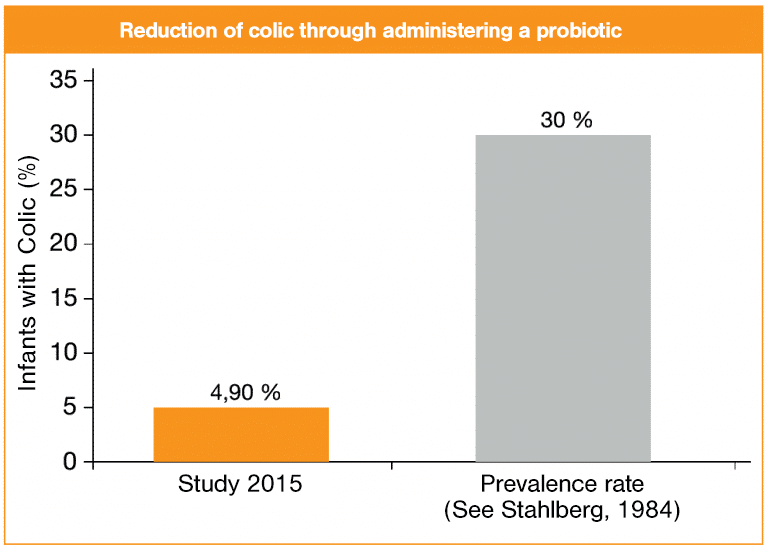
Your infant’s intestines can be supported with special, highly effective probiotics. A study in which the infants received a probiotic in the first 4 months of life showed that the crying duration in newborns decreased significantly. Of the children studied, only 4.9% showed the characteristics of excessive crying (regulation disorders) – whereas usually about every third child is affected. Even children who are more prone to regulation disorders due to familial predisposition were not more frequently affected by excessive crying or colic (Hofmann, 2018).
Avoiding foods that cause digestive problems for the mother also helps to relieve baby’s bloating. If you as a breastfeeding mum get flatulence yourself, e.g. by drinking cow’s milk or consuming products with yeast, then the likelihood is very high that the newborn baby will react similarly. True to the motto: If you are well, your baby will be well too!
Source:
Hofmann, H., (2018). The microbiome in digestive disorders in pregnancy and infant colic. Speculum – Journal of Gynaecology and Obstetrics 2018; 36 (4) (Issue for Austria), 23-24.