


Metabolism - what is that?
Digestion is an important part of metabolism; it is, so to speak, the “preliminary stage”. Metabolism encompasses all biochemical processes and procedures in our cells. These include tasks such as extracting nutrients from food, providing energy when the body needs it, and removing waste products from the body. Metabolism consists of several metabolic processes: glucose metabolism, protein metabolism and fat metabolism. When all metabolic processes are functioning optimally, it is easier to lose weight and maintain that weight in the long term.
Should I go on a diet?
Our starvation response is a phenomenon that is often overlooked. Some people go on extreme diets so that they can lose as much weight as possible in the shortest possible time. During this time, they usually eat a very unbalanced diet and have a negative energy balance for days or even weeks. This means that they consume less food than the body needs to maintain its basic functions. This negative energy balance, also known as a calorie deficit, is initially seen as optimal because the results can be seen very quickly in the mirror or on the scales.
The starvation response is an emergency programme in our body that enabled humans to survive despite hunger millions of years ago. This emergency programme kicks in after three days with a calorie deficit of at least 500 kilocalories. In order to compensate for the missing calories from food, muscle mass is broken down first and foremost so that energy consumption decreases. Fat is also broken down, but less than hoped for. Another reason why most people lose weight quickly in the first few days of therapeutic fasting or various juice diets is that the body initially gets rid of a lot of water.
Unfortunately, even long after a diet, the basal metabolic rate remains low. The body quickly tries to build up fat reserves again so that we are prepared for the next period of hunger. Every diet we go on has a lasting effect on our metabolism. The more diets we go on, the more abundant the fat deposits become and the more our basal metabolic rate drops. This is why some people find it very difficult or even impossible to lose weight.
Boost your metabolism and lose weight – with 7 tricks!
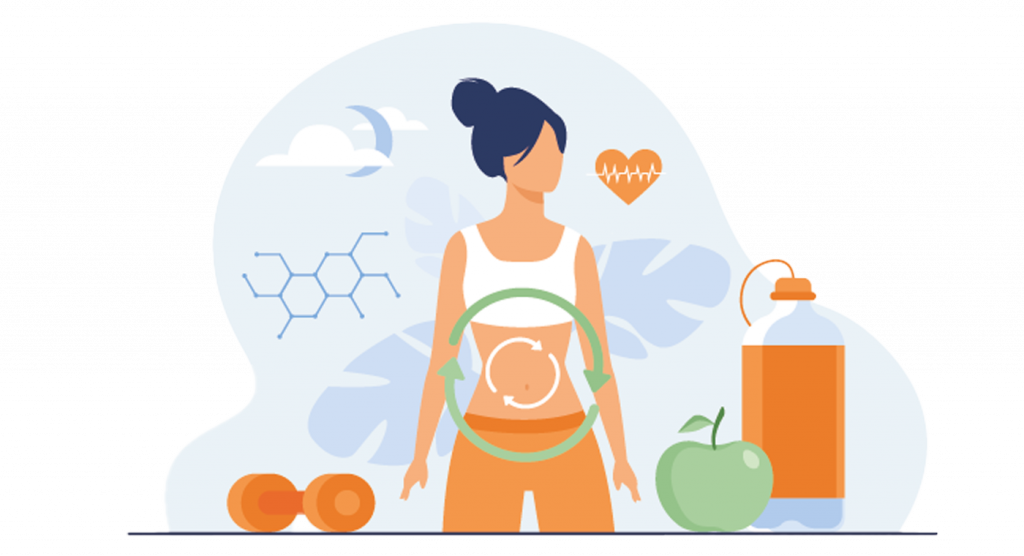
To keep your metabolism active rather than letting it slow down, you should keep these tips in mind:
Step 1: Forget about unbalanced starvation diets
As described above, unbalanced diets with very strict calorie restrictions are not suitable for helping you achieve your ideal weight. Your primary goal should not be to lose weight, but to lose fat. The next step explains how you can achieve this.
Step 2: Exercise regularly

Our bodies need a certain amount of energy every day to survive. This energy is referred to as our basal metabolic rate. If we consume more energy (food) than we use during the day, it is stored in our fat tissue and muscle cells. When we exercise or are very active in our daily lives, our bodies can specifically draw on this stored energy. Therefore, the best way to burn calories is to exercise regularly. But not all exercise is the same. To lose weight in the long term, a combination of strength training and endurance training is recommended. Strength training is the most effective way to keep your metabolism active. This means that you not only burn energy during training, but also afterwards when you are at rest, thanks to the muscle mass you have built up.
Step 3: Focus on foods that stimulate the metabolism

Yes, you can boost your metabolism with food! Even for a few hours. This effect is called the thermic effect of food and is the extra energy that the body needs to digest food. However, there are also individual foods that boost metabolism. Proteins, for example. Unlike fat and carbohydrates, protein-rich foods boost metabolism. The reason for this is that the body has to expend a lot of energy to digest the protein and break it down into amino acids. Proteins also keep you feeling full for longer and prevent cravings! But fibre-rich foods are also real metabolism boosters! These include wholemeal products, oat bran, legumes and vegetables.
Step 4: Drink plenty of fluids

Water is a valuable elixir for our bodies. It helps it to perform all its important tasks and is particularly important for digestion. It is recommended to drink around 1.5 litres of water per day. Studies show that just 500 millilitres of water increases energy consumption by 24 per cent for the next 60 minutes. It is also recommended to drink water instead of sugary drinks. This automatically reduces calorie intake and makes it easier to maintain your weight.
Step 5: Get enough sleep

Sleep is very important for metabolism, especially deep sleep during the first three hours. Disturbed or insufficient sleep can lead to obesity and generally has a negative effect on metabolism. Adequate sleep is also very important for athletes, because the muscles that are used during exercise regenerate during sleep. What many people do not know is that poor or insufficient sleep increases the hunger hormone ghrelin and, at the same time, reduces the satiety hormone leptin. This often leads to people with sleep deprivation being hungrier and having difficulty losing weight.
Step 6: Stress less

Stress is a real metabolic brake! Relaxation and stress reduction are just as important for your feel-good weight as exercise and nutrition. Constant stress leads to excessive release of the stress hormone cortisol. The body reacts to this with a defensive response, slowing down fat metabolism, preventing regeneration processes from being carried out completely and storing water. Stress often leads to sleep problems, which in turn increases cortisol release.
Step 7: Balance your gut bacteria!

Have you ever heard of so-called “fat-storing bacteria“ and “figure-flattering bacteria”? Numerous studies confirm that the intestinal flora of overweight people is usually different from that of people of normal weight.
An imbalance between these types of bacteria can therefore be responsible for stubborn weight. This also explains why many people go on diets year after year – and almost always with the same result: after losing a few centimetres from their waistline through considerable sacrifice and strenuous exercise, the yo-yo effect quickly causes the needle on the scales to shoot back up again. And for many, nothing goes down – except their good mood. An excess of “fat-storing bacteria” in the gut is largely responsible for this. Normally, Firmicutes and Bacteroidetes are present in the gut in a balanced ratio. Studies have shown that Firmicutes significantly predominate in overweight people and that the ratio between “fat-storing” and “figure-flattering” bacteria can be as high as 2,000:1.
What is the difference between catabolic and anabolic metabolism?
If you want to boost your metabolism, you first need to understand the difference between catabolic and anabolic metabolism. Catabolic and anabolic metabolism never occur simultaneously, but always one after the other. Hormones and enzymes ensure that this process runs smoothly.
Catabolism
Catabolism is the breakdown of metabolism. In this process, the food we consume is broken down into individual molecules and chemical compounds, and energy is obtained. For example, proteins are converted into amino acids and carbohydrates into simple sugars. Excess energy that the body no longer needs for vital functions is stored in fat or muscle cells.
Anabolism
Anabolism is the metabolic process that ensures the construction and repair of cells. The previously broken down amino acids, fatty acids and glucose are converted back into larger components such as proteins, fats and complex carbohydrates and can be used for other functions such as muscle building, wound healing, blood renewal or general cell renewal.